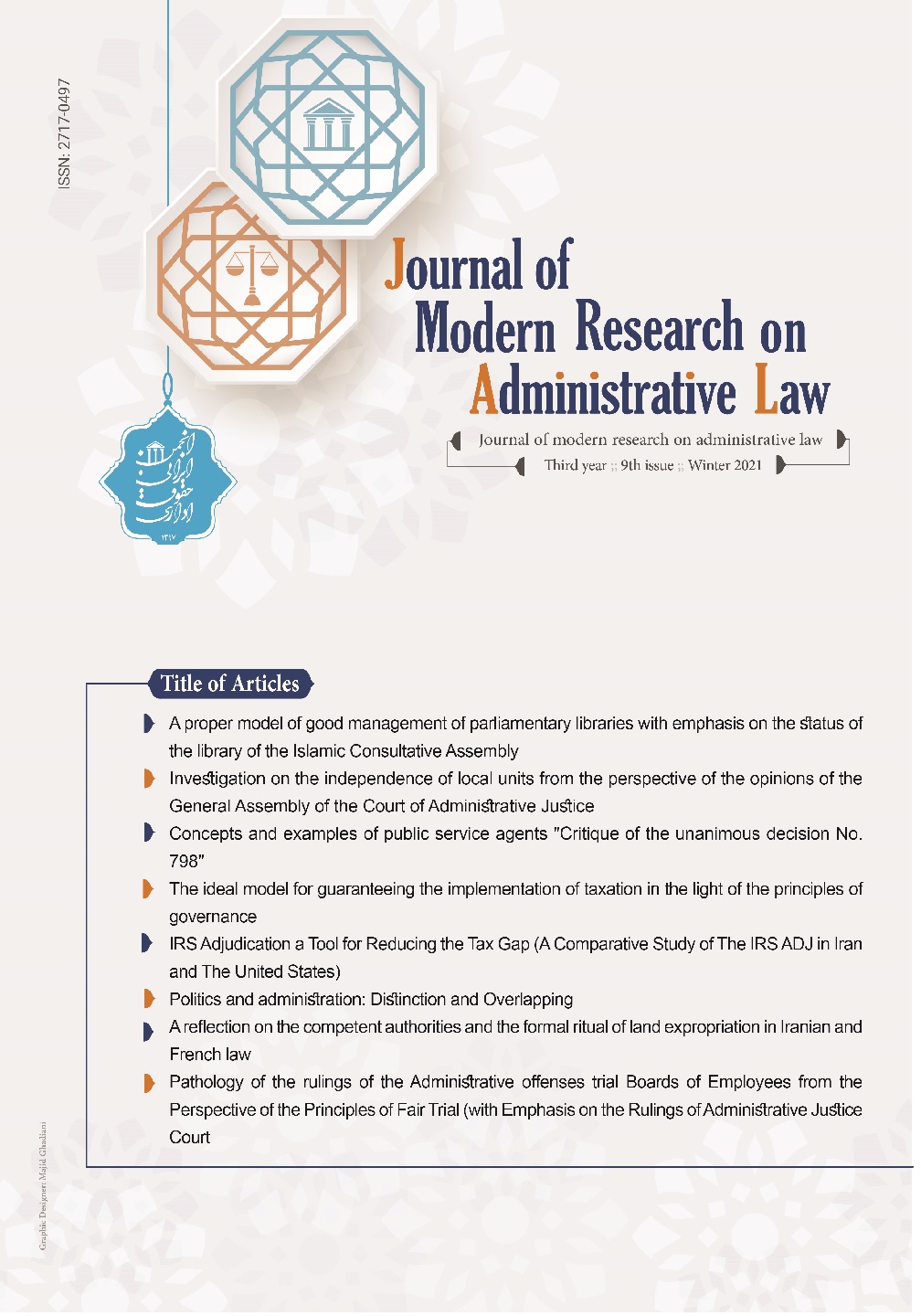
Document Type : Original Article
Highlights
Observance of the principles of fair trial in the investigation of administrative offenses of employees by the Administrative offenses trial Boards is required to guarantee their rights. In addition to the general principles of fair trial, there are some other principles, such as the prohibition of the imposition of more than one punishment, which, as the case may be, are provided for in the laws and regulations for the the investigation of administrative offenses.
Despite the special importance of observing the principles of fair trial in dealing with administrative offenses, reflection on the reasons for violating the Rulings of administrative offenses trial Boards in the Administrative Justice Court indicates that in two areas of the process of investigation and applying administrative penalties, observing the principles with restrictions and There are challenges in the Administrative offenses trial Boards.
1- Non-observance of the principles of fair trial in the trial process
It happens in the following cases:
1-1- Non-observance of the formalities related to the notification of the charge
Failure to comply with the notification procedures happens in the following cases:
C- Defects in the contents of the indictment - In order to ensure the possibility of proper defense for the accused, the indictment must explicitly state the subject of the indictment, such as acts and behavior contrary to professional or administrative matters or violations of laws and regulations, which are all general. If the accused employee does not know why and on what subject he has violated the rules and regulations, he cannot defend
2- 1- Not hearing the defendant in person
The presence of the accused in the trial is an important element in the right to self-defense, and on the other hand, the ability to face the judge and the plaintiff increases the credibility of the trial and helps to discover the truth. In both cases, the board is conducted in the presence of the accused. First, the panel deems it necessary for the defendant to be present at the hearing. Second, the accused must request in writing to appear at the hearing in person. In both cases, the board is obliged to invite him to attend the meeting once.
3-1- Documents are not documented and reasoned
The rulings of the Administrative offenses trial Boards, like the rulings of the judiciary, must be reasoned and documented. According to Article 21 of the Executive Regulations of the Law on Administrative offenses, the rulings of the boards must be reasoned and documented in accordance with the law and regulations, and issuing a verdict without observing the above rule, which is one of the basic principles of Trial, does not comply with legal regulations.
4-1- Non-observance of the rules of handling new charges by the Board of Appeals
If the employee commits a new offense after the decision of the Board of First Instance until the hearing of the objection, the employee's new offense or offenses are within the jurisdiction of the preliminary Board and the Board of Appeal has no fundamental right to hear the case.
5- 1- Lack of consideration in a reasonable time
One of the conditions of a fair trial is that it be as quick as possible, and on the other hand, the defendant's acquittal is only reasonable and appropriate if his innocence or guilt is clarified as soon as possible, so the preliminary and Appeal boards are obliged to investigate the administrative offenses and to assign their duties immediately and to issue an appropriate verdict as soon as possible.
2- Non-observance of the principles of fair trial in the field of administrative penalties
Non-observance of a fair trial by the boards in the field of administrative penalties includes the following:
1-2- Failure to observe the proportionality between the offense and the punishment
In investigating administrative offenses of employees, the observance of the proportionality between offenses and punishments by the Administrative offenses trial Boards in determining the amount of punishment for violating employees, according to the principle of proportionality of crime and punishment, as one of the principles governing penalties in criminal law, is definite. Based on this principle, it should be said that the amount of administrative punishment for offending employees depends on the severity and non-severity of the offense committed, and any offense should be dealt with in accordance with its conditions.
2-2- Intensification of punishment
Prohibition of aggravating the employee's punishment is a principle in subsequent proceedings. Because with the intensification of punishment, the employee's situation worsens. By imposing a light punishment on the accused, a kind of acquired right is created for him and prescribing severe punishment in subsequent hearings denies this right and to the detriment of the accused, which is prohibited by law. In other words, the appeal of the decisions of the first instance panels is exclusively to consider the plaintiff's objections in terms of abuse of his right, and the decisions of the first instance panel, assuming non-compliance with the rules, are final and binding if the plaintiff does not object. Therefore, the aggravation of the plaintiff's punishment as an appellant has no legal status.
3-2- Applying more than one punishment
Pursuant to Note 4 of Article 9 of the Administrative offenses Trial Law, in the event of a offense or offenses, the Boards will apply only one of the penalties subject to this law in each case.